

Anyone who has ever set foot in Metro Manila knows the agonizing reality of its traffic. It is a slow, grinding ordeal that tests the patience of even the most resilient commuters. But beyond the frustration of long commutes and missed appointments lies a far more critical hazard. For emergency response vehicles—ambulances rushing critical patients to the hospital, fire trucks speeding toward a developing blaze, and rescue teams responding to urgent calls—these congested roadways represent a barrier that can cost lives. In emergency situations, every single second counts, yet emergency vehicles are routinely trapped in bumper-to-bumper gridlock, their sirens blaring helplessly in a sea of unmoving cars.
Recognizing this urgent humanitarian and logistical challenge, the Department of Science and Technology has stepped forward with an innovative technological solution. Through its Advanced Science and Technology Institute, the agency recently introduced the Swift Emergency Response Vehicle Integration System with Smart Traffic and Electronic Enforcer on the Road, highly recognizable by its acronym sERVis-STEER. This project marks a significant milestone in the country's journey toward integrating smart-city technologies into public safety operations. The primary objective is simple yet life-saving: to enable emergency vehicles to navigate heavy traffic more efficiently and safely than ever before.
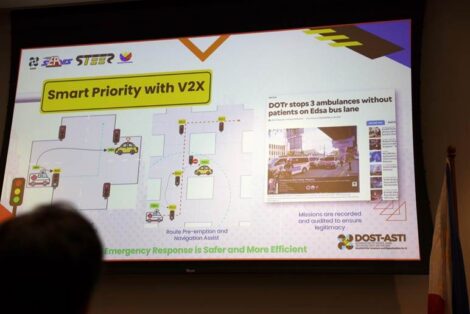
At the heart of the sERVis-STEER system lies Vehicle-to-Everything wireless technology. Unlike traditional emergency navigation, which relies on standard GPS routes and manual lane clearing, V2X allows emergency vehicles to actively communicate with their surrounding environment. This wireless communication network links the emergency vehicle directly to roadside units, traffic signals, and localized traffic management infrastructure. As an ambulance or fire truck approaches an intersection, it transmits a digital request for right-of-way. The traffic lights, acting as intelligent nodes in the network, process this request in real-time, adjusting their patterns to grant a green light for the arriving emergency vehicle while holding back cross-traffic.
This intelligent manipulation of traffic signals creates what urban planners call a green corridor. Instead of relying on drivers to scramble and clear lanes in tight spaces—which is often physically impossible on narrow, clogged Manila streets—the traffic infrastructure itself clears the way. Additionally, the sERVis-STEER system can automate routes based on real-time traffic density, steering emergency drivers away from severely gridlocked areas and directing them along roads where green corridors can be established most effectively. This dynamic routing reduces cognitive load on emergency drivers, allowing them to focus entirely on navigating the vehicle safely.
The development of sERVis-STEER by Filipino engineers at DOST-ASTI is a testament to local innovation. For years, the Philippines has faced fragmented urban planning, with different cities in the metropolitan area operating independent traffic management systems. By creating a unified, locally designed V2X solution, DOST is laying the groundwork for a standardized protocol that can be adopted across various local government units. It represents a shift from passive monitoring to active, automated traffic management—a necessary evolution for a metropolis striving to become a true smart city.
Of course, deploying such a sophisticated system is not without its hurdles. To achieve full integration, sERVis-STEER will require close cooperation between DOST, the Metropolitan Manila Development Authority, and individual local government units. Roadside units must be physically installed at key intersections, and older traffic signal systems must be upgraded to support V2X communication. Furthermore, robust cybersecurity measures must be established to prevent unauthorized access or disruption to the smart traffic grid. Despite these challenges, the potential benefits—specifically, significantly reduced response times and a reduction in traffic-related emergency fatalities—far outweigh the initial setup costs.
As sERVis-STEER progresses through its testing and validation phases, it offers a hopeful glimpse into the future of Philippine infrastructure. It proves that technology, when applied with empathy and local context, can solve some of our most deeply rooted societal issues. It is a proud moment for Filipino science and a reminder that our local researchers are capable of developing world-class solutions to local problems.
According to a report by Inquirer, this smart traffic system is poised to redefine emergency logistics in Metro Manila, serving as a blueprint for other urban areas across the archipelago. By prioritizing the movement of those who save lives, we take a step closer to a safer, more responsive nation.
#BalitaBNB #NewsUpdate