

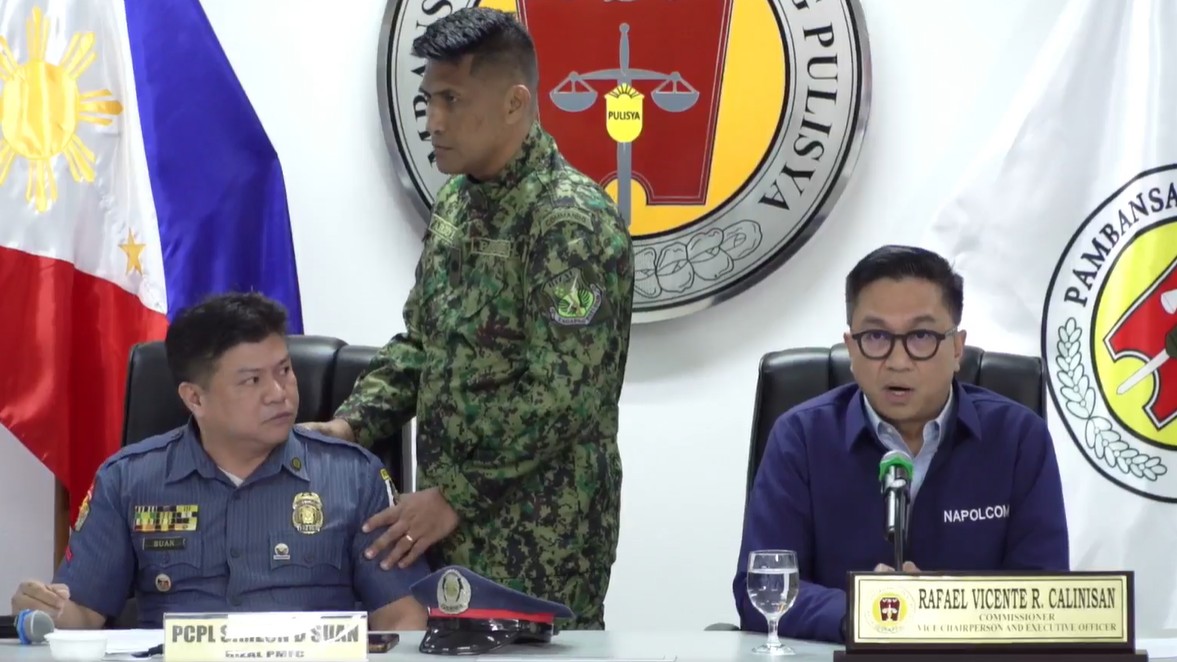
To understand the gravity of this confrontation, one must look closely at the roles of the actors involved. NAPOLCOM is the constitutional body mandated to administer and control the Philippine National Police (PNP). It serves as the ultimate civilian oversight agency, tasked with ensuring that those who wear the badge adhere to the highest standards of professional conduct and human rights. Atty. Calinisan, known for his vocal stance on police reform and swift disciplinary action, represents the regulatory and regulatory arm of this oversight system. On the other side of the room stood an officer whose recent actions on camera had already drawn widespread public scrutiny and fierce condemnation from citizens.
Historically, the relationship between civilian oversight bodies and the active police force in the Philippines has always been complex. Under Republic Act No. 6975, which established the PNP under a reorganized Department of the Interior and Local Government, the legislative intent was to foster a highly capable, effective, and credible police force that is civilian in character. NAPOLCOM was envisioned as the essential bridge between the civilian population and the armed police service. Yet, systemic issues, procedural delays, and cultural barriers within the force have often hindered smooth operations. This latest public clash is a physical manifestation of these historic, unresolved frictions.
The argument erupted during what was supposed to be a routine question-and-answer session with reporters. As journalists watched in real-time, the professional veneer of the press conference cracked. The exchange began with sharp inquiries regarding the officer’s conduct in the viral video—an incident that had already raised serious questions about police protocol, roadside behavior, and the use of authority. Rather than the typical bureaucratic deflections or formal statements, the interaction quickly became intensely personal and heated. Voices were raised, fingers were pointed, and the underlying tension between civilian authorities and active-duty officers became painfully visible to everyone present.
This dramatic incident highlights a much broader, systemic issue within the landscape of contemporary Philippine law enforcement. Over the past several years, social media has transformed into an unofficial public watchdog. Armed with smartphones, everyday citizens regularly record and upload encounters with law enforcement officers. While this digital democratization has brought unprecedented transparency, it has also created an environment of heightened defensiveness among some members of the police force. When viral videos capture moments of perceived arrogance, abuse, or misconduct, the public demand for swift justice is immediate and overwhelming.
For officials like Commissioner Calinisan, the pressure to act decisively is immense. Public trust in law enforcement is a fragile commodity, easily damaged and notoriously difficult to rebuild. When a representative of the civilian oversight board publicly challenges an officer, it serves as a powerful signal to the public that misconduct will not be swept under the rug or ignored. However, when such challenges occur in a highly emotional, public forum like a live press conference, it also risks exposing the internal friction and lack of cohesion within the disciplinary process itself.
Observers of the confrontation have pointed out that while public accountability is essential, the breakdown of decorum during an official briefing can be a double-edged sword. On one hand, it showcases a raw, uncompromising pursuit of truth, proving that high-ranking civilian officials are willing to directly confront those accused of overstepping their bounds. On the other hand, critics argue that such public spectacles can undermine the perceived professionalism of both the oversight body and the police force, potentially alienating rank-and-file officers who may feel that the system is more interested in public relations than structured due process.
The broader implications of this heated argument stretch far beyond a single press conference. It raises critical questions about how the Philippine National Police and NAPOLCOM handle internal discipline in the digital age. How do we balance the need for rapid public accountability with the constitutional right to due process? More importantly, how can the civilian oversight system effectively reform police culture if the interactions between regulators and officers are defined by mutual hostility rather than constructive correction and institutional trust?
As the dust settles from this remarkable confrontation, both NAPOLCOM and the PNP find themselves at a critical crossroads. The public will undoubtedly continue to demand transparent, decisive action regarding the officer's original viral incident, as well as an inquiry into the decorum displayed during the press conference itself. What remains clear is that the struggle for police accountability in the Philippines is no longer confined to closed-door hearings and official resolutions; it is being played out in real-time, in front of rolling cameras, and under the watchful eye of millions of Filipinos worldwide.
According to a report by GMA News, the heated exchange has already prompted discussions on the review of disciplinary protocols during public inquiries.
Data sourced from GMA News.