

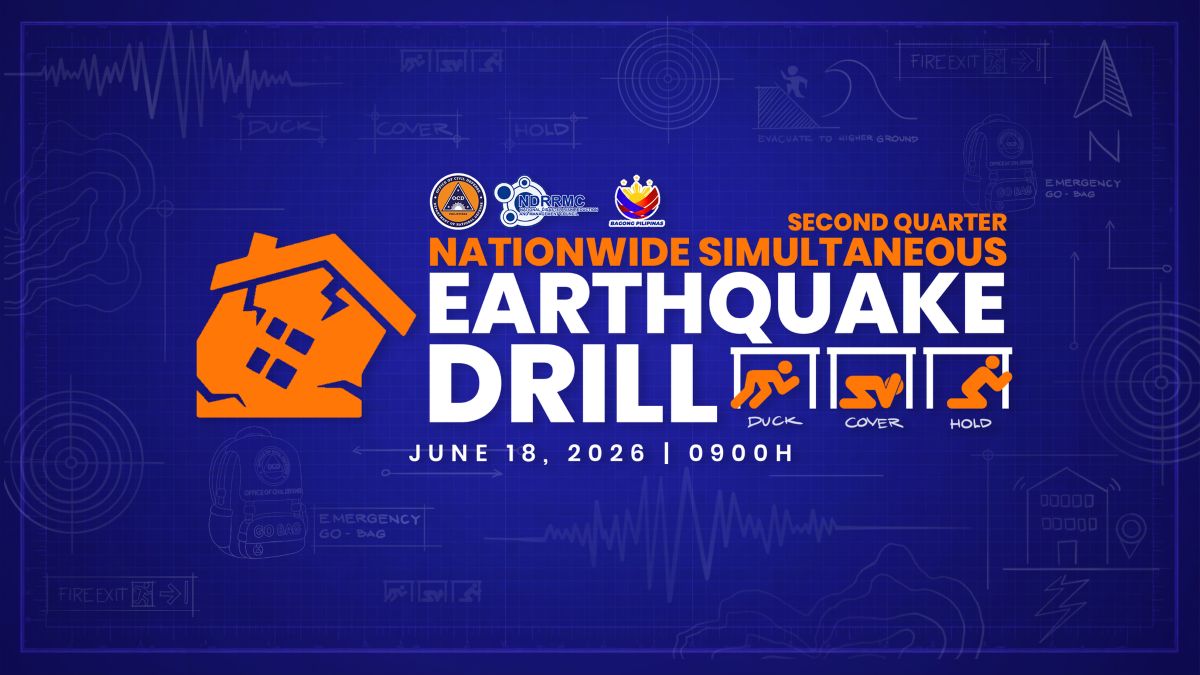
Living in a country beautiful yet seismically active as the Philippines means disaster preparedness is not just a government checklist—it is a vital component of daily survival. Positioned directly on the western rim of the Pacific Ring of Fire, our archipelago is constantly shaped by tectonic shifts, volcanic activity, and the silent, grinding movements of undersea trenches and fault lines. It is against this backdrop of natural vulnerability that the Office of Civil Defense has officially announced the scheduling of the Second Quarter National Simultaneous Earthquake Drill for Thursday, June 18, 2026.
According to an official advisory released by the Office of Civil Defense, and as initially reported by GMA News, this nationwide drill serves as a critical quarterly checkpoint to evaluate and enhance the country's disaster response capabilities. The primary goal of this exercise is to keep the public highly alert, test the communication protocols of local government units, and ensure that emergency response teams can mobilize swiftly and seamlessly in the event of a major earthquake.
To understand why these quarterly drills are so critical, one only has to look at our history. The memory of the devastating 1990 Luzon earthquake, which claimed thousands of lives and permanently altered the landscape of northern cities like Baguio, remains a stark reminder of the destructive power of nature. More recently, constant low-to-moderate tremors felt across parts of Luzon, Visayas, and Mindanao continue to remind us that the earth beneath our feet is far from static. Seismologists have long warned about the potential movement of the West Valley Fault—a major active fault system running through parts of Metro Manila and neighboring provinces—which could trigger a magnitude 7.2 earthquake, colloquially feared as the "Big One."
Because we cannot predict exactly when a major rupture will occur, preparation remains our strongest shield. The June 18 earthquake drill is designed to build muscle memory across all sectors of society. When the ground begins to shake, human instinct often leads to panic, which can result in stampedes, disorientation, and poor decision-making. By practicing the classic "Duck, Cover, and Hold" protocol repeatedly, citizens from all walks of life—from elementary school students to corporate executives—can condition themselves to react calmly and purposefully in those critical first few seconds of a tremor.
This upcoming exercise will require the active cooperation of various sectors. The Office of Civil Defense is calling on national government agencies, local government units, academic institutions, private corporations, and ordinary households to participate. During the drill, organizations are expected to simulate evacuation procedures, test alarm systems, designate safe open spaces as assembly points, and conduct headcount audits. Beyond the physical action of ducking and covering under sturdy tables, the drill is also an opportunity for local government units to evaluate their disaster management command structures, check the operational status of emergency communications equipment, and identify potential bottleneck areas in local evacuation routes.
For families and individuals, the drill serves as an annual reminder to review their own domestic disaster readiness plans. Safety experts emphasize that survival starts at home. Families are highly encouraged to prepare and update their emergency go-bags, which should contain essential items like clean drinking water, non-perishable food, first-aid kits, critical prescription medications, flashlights, whistle, and power banks. Knowing who to contact and where to meet if family members are separated during an emergency is equally crucial, and this drill provides the perfect window to discuss these emergency protocols with loved ones.
Ultimately, disaster resilience is a shared national responsibility. The Office of Civil Defense continues to emphasize that public safety cannot be achieved by government agencies alone; it requires a culture of preparedness deeply ingrained in every citizen. By taking the time to participate seriously in the Nationwide Simultaneous Earthquake Drill on June 18, 2026, we are investing in our collective safety and ensuring that when the ground eventually shakes, our communities stand resilient and prepared.
Data sourced from the Office of Civil Defense and GMA News.