

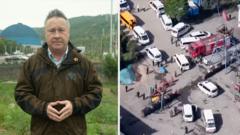
There is a profound, chilling silence that settles over a mining community in the aftermath of a catastrophe. It is a silence that speaks louder than any siren or emergency announcement ever could. Recently, the world turned its collective gaze toward the Liushenyu mine in China, where a horrific gas explosion has claimed the lives of at least 82 individuals. As reports filter out from the site, the sheer scale of the loss begins to settle in, marking this event as the most devastating mining disaster the country has witnessed in more than a decade. For those of us watching from afar, it is easy to view such events as mere statistics, but each of those 82 souls represents a father, a son, a brother, and a story cut tragically short beneath the surface of the earth.
Mining has long been the backbone of industrial development, driving the power grids and heating systems that fuel our modern existence. Yet, this industry is fraught with invisible dangers. Gas explosions, often caused by the sudden release of methane—a highly volatile and flammable gas trapped within coal seams—are the nightmare of every subterranean operation. When ventilation systems fail or spark prevention protocols are even slightly compromised, the results can be catastrophic. The Liushenyu incident serves as a grim reminder of how thin the line is between routine extraction and absolute devastation. It forces us to reconsider the human cost of the resources we consume so casually in our daily lives.
Looking back, China has struggled for years to reconcile its massive industrial hunger with the need for safer working conditions. Following a series of high-profile accidents in the early 2000s, there were significant legislative shifts and crackdowns on illegal or poorly regulated "mom-and-pop" mines. For a time, it seemed like the tide was turning, with safety standards tightening and old, dangerous shafts being shuttered across the provinces. However, the sheer demand for energy, especially in shifting economic climates, often creates pressure that tests the limits of these hard-won safety improvements. When we see a tragedy of this magnitude, it inevitably sparks a national conversation about whether the push for production is still outpacing the necessary safeguards designed to protect the people at the front lines of the industry.
Rescue efforts in such scenarios are notoriously difficult. When a massive gas explosion rips through the tunnels of a deep mine, it leaves behind structural instability, toxic gas pockets, and a landscape that is fundamentally altered. Rescuers often have to work against time, contending with debris and the risk of secondary collapses. The families waiting at the surface, hoping against hope, face an agony that most of us will never fully understand. These disasters often reveal systemic flaws, whether in the infrastructure, the management of safety protocols, or the oversight of the mining operations themselves.
As investigators begin the arduous task of piecing together exactly what triggered the explosion at Liushenyu, the global community waits to see what lessons will be learned. Will this be a catalyst for a new wave of safety reforms, or will it be another instance where the tragedy is eventually eclipsed by the next news cycle? The legacy of the 82 lives lost in Liushenyu depends largely on the answer to that question. True progress in industrial safety isn't measured by economic growth or production quotas; it is measured by the ability of a society to ensure that every worker returns home at the end of their shift.
We must continue to hold a light to these dark corners of industry. By discussing the risks, acknowledging the history of these struggles, and demanding accountability, we honor the memory of those we have lost. It is a somber reminder that behind every light switch we flip and every engine we start, there is an invisible chain of human effort, often fraught with peril. Let us hope that the sorrow being felt by the families in Liushenyu today leads to a safer, more transparent future for all who labor in the deep.